Until the mid-17th century, few Europeans outside of the Ottoman Empire had tasted coffee. Its European debut was believed to be in Venice around the year 1575. From there, the drink spread quickly throughout Italy and eventually across Europe.
Vienna played an important role in this development, and it was here that coffee was first refined with milk. Named after the brown robes of the Capuchin monks, this was the precursor to today’s cappuccino.
When the Ottoman Empire prohibited the export of coffee beans towards the end of the 17th century, the European colonial powers searched for new regions for cultivation. Initially, the newly cultivated coffee came mostly from Java, at that time part of the Dutch East Indies, now Indonesia. Later, cultivation shifted to the Caribbean. This expansion of plantation farming led to the clearing of large areas of forest and the destruction of local ecosystems. Production also relied initially on enslaved labour and later on similarly inhumane forms of indentured labour.
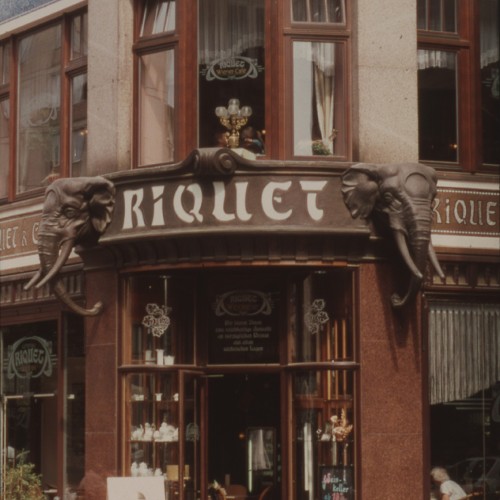
Meanwhile, from the 17th century onwards, a lively coffee-house culture developed in Europe. It was now possible to consume the products of colonisation such as coffee, chocolate, tea and sugar under one roof. One such classic coffeehouse, Café Riquet in Leipzig, established in 1908, also exemplifies the relationship with Orientalism. Emerging from Riquet & Co., founded in 1745 as a colonial goods trading company, the café was built in 1908 to designs by the architect Paul Lange. The building combines Art Nouveau motifs with elements from East Asian architecture and thus connects visually to the global trading network. Riquet’s advertising materials also drew on this visual language: European fantasies were combined with stereotypical depictions of East Asia. Around 1900, the enjoyment of coffee was closely intertwined with colonial trading networks and the exoticisation of other cultures.