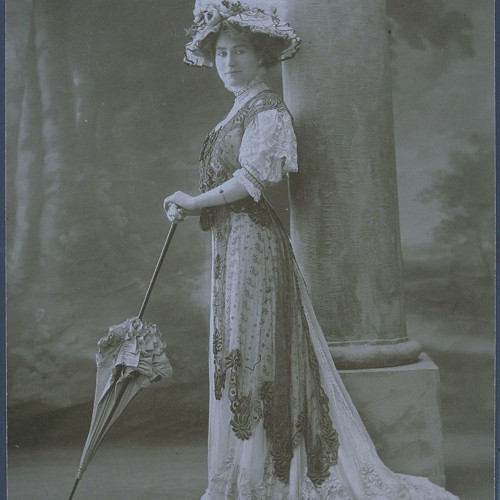
Haute couture emerged in Paris in the mid-19th century. Its founder was an Englishman, Charles Frederick Worth, born in Bourne in 1825. His fashion marked the beginning of modern fashion design and a brand mentality that continues to this day.
Before Worth, the names of dressmakers did not carry much weight. And the dressmakers themselves simply carried out their clients’ wishes. Worth broke with this tradition: he saw himself as an artist and designed seasonal collections according to his own vision. He was the first to sew his name label into his garments as a trademark.
After an apprenticeship in London, Worth began working in Paris in 1845 for the renowned silk merchant Gagelin (pr. Gazj-lan). Instead of presenting his designs on wooden mannequins, he was the first to show them on a living model: his wife. And so the story of the fashion mannequin began. Following his successes at the world exhibitions, he opened his fashion house at 7 Rue de la Paix in Paris in 1858, bringing fabric sales and bespoke tailoring together under one roof.
Alongside Empress Sisi of Austria and the actress Sarah Bernhardt, the French Empress Eugénie became his most important client and patron. A dress he had made for the Princess of Metternich brought Eugénie’s attention to Worth. She appointed him her official court dressmaker and thus helped make him a global fashion icon. Distributed on a mass scale, photographs and fashion magazines carried Worth’s style around the world.
He transformed fashionable silhouettes, shifting the fullness of the crinoline towards the back and creating the bustle. The flowing “Princess line”, without a waist seam, and the ankle-length walking skirt can also be traced to Worth and Empress Eugénie. Eugénie deliberately used fashion as an economic force to strengthen France’s domestic silk and lace industries. Paris established itself as the centre of luxury fashion.
After Worth’s death in 1895, around 1900 his sons led the fashion house into a period of economic prosperity. In the long term, however, the label was unable to withstand modern competitors such as Coco Chanel. In 1954, the historic Worth fashion house closed following its merger with the fashion house Paquin.