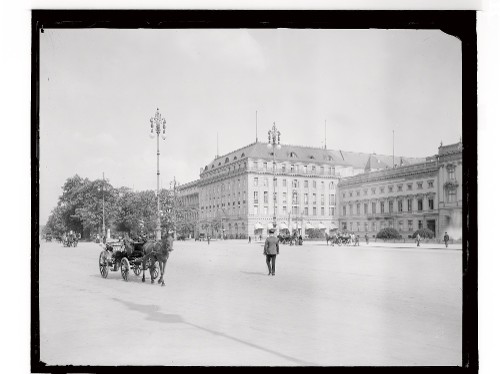
On 26 October 1907, Kaiser Wilhelm II opened the Hotel Adlon on Pariser Platz in Berlin as the city’s most prestigious palatial hotel. It offered more luxury than the imperial residence itself. Its founder, Lorenz Adlon, a skilled cabinetmaker from Mainz, had a great talent for hospitality and marketing. Following a time in Amsterdam and Berlin, he acquired the property next to the Brandenburg Gate in 1905. With the Kaiser’s permission and financial support, Palais Redern was demolished to make way for this flagship project. The architects Carl Gause and Robert Leibnitz completed construction of the hotel in just two years.
The Adlon stood out for its state-of-the-art technology and deluxe materials. Almost every room had its own bathroom with marble, hot water and central heating – a novelty that filled bathtubs within minutes and made the Kaiser a regular guest in winter. Electricity, lifts, hand-crafted mahogany furniture, crystal chandeliers and fine fabrics lent a distinctive character to spaces such as the Marble Hall and the luxury restaurant. An elephant fountain, a gift from the Maharaja of Patiala, stood in the hotel’s Goethe Garden.
The hotel became a social magnet for international guests such as Charlie Chaplin and Marlene Dietrich, as well as for European high society. After Lorenz Adlon’s death, his son Louis took over the business. Together with his second wife Hedda, who organised successful social events, he became a high society figure.
From 1930 on, initially the NSDAP avoided the international hotel, but during the Second World War, it was partly used as a military hospital. In 1945, a fire started by Soviet soldiers destroyed the hotel, leaving only one wing standing. The expropriation of the hotel in the early years of the GDR and the demolition of its ruins in 1984 brought its history to a temporary halt. It was not until 1997 that the Adlon Kempinski was rebuilt – true to the original at its historic location.