These days, advertising is unavoidable. Not only does it inform us about products, it also shapes our ideas about the world. Advertising as we know it emerged in the mid-19th century. Technical advances, such as colour lithography and the rotary printing press, made it possible to reproduce and distribute advertising images in large quantities.
Industrialisation and colonial-imperial expansion ushered numerous new products such as coffee, cocoa and tea onto the market, where they quickly became sought-after consumer goods. Thanks to advertising, new brands were able to establish themselves on the expanding mass market.
Advertising images from this time were informed by racist, sexist and colonial hierarchies and contributed to reinforcing a Eurocentric view of the world that continues to impact today.
Around 1900, mass dissemination of such images reached an initial peak: the presentation of goods from colonised regions as everyday consumer products created the illusion of “participation in the conquest of the world”. Here, we can see various advertising strategies at play.
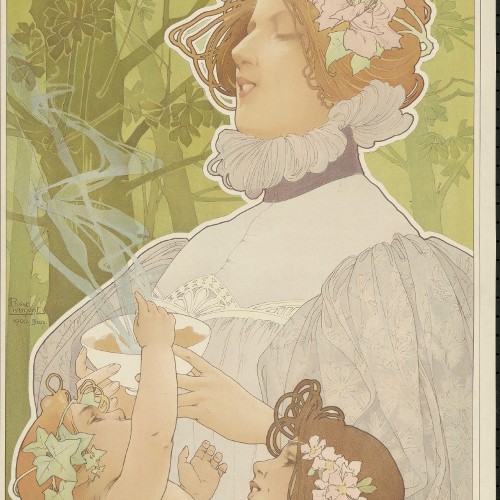
Idealised depictions showed bougeois idylls: European mothers and their children alongside their pets are seen consuming chocolate. The colonial conditions of production, however, remain invisible. The advertising poster for A. Driessen Cacao, designed by Privat Livemont, shows an elegant woman with two children reaching expectantly for a cup of hot chocolate – an image of security and prosperity founded on the profits of colonial trade.
Advertising images also reduced people from colonised territories to racist stereotypes. The poster for “Fry’s Cocoa and Chocolates” shows a group of Black men fighting over chocolate crates that have been washed ashore. Thus reversing the power relationship as it actually stood. The fact that European colonial powers systematically exploited people and resources in Africa is conveniently swept under the carpet.
Alongside large-format posters, collectible picture cards also became widespread. A collector’s card from Schwerter Cocoa, produced by Riedel and Engelmann, depicts the so-called “Herero Uprising”. It conceals German colonial violence and the genocide of the Herero and Nama while instead portraying the Herero as a threat.